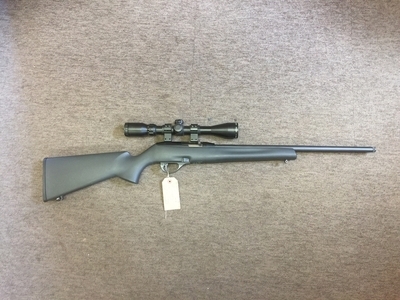
Steyr Mannlicher Jeff Cooper Scout Bolt Action .308 Winchester Rifle
.308 STEYR SCOUT JEFF COOPER LIMITED EDITION UNFIRED COLLECTORS CONDITION!
Fitted with a Leupold FX-II2.5x28mm Scout Scope With factory hard case, sling, 2 high capacity magazines, 3 extra high capacity magazines, and a certificate of authenticity.
Caliber: .308 Winchester/7.62×51mm NATO or 7mm-08 Remington for locales that forbid civilian ownership of cartridges in chamberings adopted by military forces or for its "slightly better ballistics." As Cooper wrote, "A true Scout comes in .308 or 7mm-08." Cooper had his "Lion Scout," chambered in .350 Remington Magnum. I personally would have went with the .358 Winchester because it is based on the .308 case, with a neck blown out to .35 caliber.
Action: Cooper's prototype scout rifles were all bolt-actions. He did say though that "if a semiautomatic action were made which was sufficiently compact and otherwise acceptable, it should certainly be considered". Of the actions out there at the time Mr. Cooper considered the Brno ZKK 601 action to be the closest to the guidelines. A bolt-action two-lug, 90° rotation was favored. So too the Mauser claw extractor. The safety should be positive and include three positions. It should disconnect the trigger mechanism rather than blocking it. It shouldalso work from front to rear, rear position "safe" and forward "fire."
Trigger: A crisp 3lb release. Cooper had his Steyr adjusted to 2 1/2lb.
Weight: unloaded with accessories -3 kg (6.6 lb) and 3.5 kilograms (7.7 pounds) the maximum acceptable.
Length: overall length of 1 meter (39 inches) or less. The weight and length parameters place Scout Rifles in the class of carbines.
Optics: a forward-mounted telescopic sight of low magnification, typically 2 to 3 power. This preserves the shooter's peripheral vision, keeps the ejection port open to allow the use of stripper clips to reload the rifle, and eliminates any chance of the scope striking one's brow during recoil. Scopes are NOT mandatory though.
Reserve sights: ghost ring auxiliary iron sights: a rear sight consisting of a receiver-mounted large-aperture thin ring, and a square post front sight on the receiver bridge and not on the end of the barrel, where it catches on things, breaks, snags and muddies up. This allows the rifle to be accurately aimed at short to medium ranges even if the scope becomes damaged.
Stock: synthetic rather than wood stocks. Heel of the butt rounded to avoid snagging on the shirt. A spare magazine stored in the butt. A retractable bipod that does not protrude from the stock.
Magazine: magazine should be so constructed as to protect the points of soft point spitzer bullets as they ride in the magazine. Some sort of magazine cutoff permitting the rifle to be used in the single-shot mode with the magazine in reserve. As an alternative to the magazine cutoff is a detachable box magazine with a double intent which could be inserted to its first stop not allowing the bolt to feed it. When desired, the magazine could be pressed into its second stop, permitting the bolt to pick up the top cartridge.
Sling: a "Ching" or "CW" sling. Cooper recommended the use of a sling as a shooting aid. The Ching sling offers the convenience of a carrying strap and the steadiness of a target shooter's sling with the speed of a biathlete's sling. (The CW sling is a simpler version of a Ching sling, consisting of a single strap.)
Accuracy: should be capable of shooting into 2 minutes of angle or less (4") at 200 meters/yards (3 shot groups)
These features dictated short, thin barrels, synthetic stocks, and bolt actions. Other optional features included a retractable bipod, detachable magazines, a butt magazine, and an accessory rail for lights and other attachments. The addition of some of these features often render the rifle technically not a scout as originally defined, but this has come to be accepted by many as still conforming to the spirit if not the letter of the concept
RESERVE FOR £99 DEPOSIT
WE CAN TAKE YOUR EXISTING FIREARM OFF YOUR LICENCE IMMEDIATELY AND ADVERTISE ON YOUR BEHALF TILL SOLD, PLEASE ASK.
*FIREARM STORAGE AVAILABLE*
Can be sent to your local RFD for £20