Thermal riflescopes give hunters a decisive edge after dark, but only when the right scope is on the rifle. The ability to detect game by heat signature alone, through fog, across open fields, or inside dense woodland, changes what is possible at night. Yet many hunters approach the purchase the same way they would a daytime optic: they compare magnification, check resolution numbers, and go with a familiar brand.
That approach leads to mismatches that show up quickly in the field, like a scope that’s too heavy for a walking hunt or a battery that dies before dawn. The mistakes hunters make when choosing a thermal riflescope tend to follow predictable patterns. Understanding them makes it easier to buy right the first time.
Mistake #1 - Choosing base magnification without considering your hunting scenario
More magnification feels like more capability, and for daytime optics, that logic often holds. At night, it works against you. When the priority is spotting game before it spots you, covering ground visually matters more than closing in on a single point. A high base magnification compresses that visual window, turning a broad landscape into a narrow corridor.
That said, high base magnification has its place. In open fields or farmland, where shooting distances are long and animals tend to move predictably across clear lines of sight, a narrower field of view is an acceptable trade-off for the extra reach. The problems begin when that same setup is carried into mixed terrain or forest, where trees, brush, and broken ground demand constant situational awareness across a wide arc. A restricted field of view in those conditions makes it easy to miss movement happening just outside the frame.
Animals rarely announce their direction of approach. In dense or varied terrain, they can shift position quickly and disappear back into cover before a narrow view has a chance to catch up. Staying aware of what's happening around you - not just along a single sightline - is what separates a productive stalk from a missed opportunity.
Christian Rysgaard, a rifle and shotgun instructor with a lifetime of hunting experience, explains:
“For my own night stalking on wild boar, base magnification on the thermal riflescope has to match the way I hunt. Because target numbers are usually low and I often need to scan a lot of ground in all directions before detecting anything at all, I am comfortable using a riflescope with higher base magnification. That works because I do not rely on the riflescope for primary detection. I use a Pulsar Merger LRF XP35 spotter for that job, as it gives me very high thermal sensitivity, medium resolution, and a broad field of view. It is my main tool for finding as much game as possible in all kinds of weather. At the detection stage, I am happy to sacrifice some detail for high sensitivity, well aware that the grainy digital zoom of the XP sensor will not add much useful information at longer distances.
Once I have detected an animal, I either rule it out because of species or gender, or move on to the identification phase. That is where the rifle is pulled out and the thermal riflescope takes over. Here I tend to favour Pulsar Thermion 2 XG models for their higher base magnification, or XL models when I want a broader starting view combined with plenty of detail through digital zoom.
In target-rich environments, however, I would make a different choice. There, a wide base field of view on the riflescope becomes more important, because too much switching between spotter and scope can make you lose track of the animal you are trying to focus on. In those situations, I would rather stick the rifle on a carbon tripod and rely mainly on an Pulsar Thermion 2 LRF XL50 riflescope with a high-resolution sensor and a broad field of view, then zoom in digitally once detection has already taken place. Riflescope already aimed and rifle ready to take the shot at any point.”
The better approach is to match base magnification to the ground you're hunting, then zoom in when needed. Moderate base magnification preserves situational awareness during the detection phase, while digital zoom handles the closer inspection once a target is located. Several riflescopes in the Pulsar Thermion 2 lineup follow this logic, offering a broad native view that can be tightened progressively without committing to a narrow frame from the start.

Mistake #2 - Ignoring ergonomics and rifle balance
A thermal riflescope does not exist in isolation. It becomes part of the rifle system, and its weight, shape, and mounting position affect how the rifle handles in every situation, from a standing shot to a long carry through uneven terrain.
Hunters frequently overlook weight distribution, control placement, and ease of operation with gloves until they are already in the field. A scope that sits too far forward shifts the rifle’s balance point. Buttons that require precise finger placement become frustrating in cold weather. Poor ergonomics slows target acquisition and makes the rifle uncomfortable during longer hunts when fatigue is already a factor.
Scopes designed with a traditional tube form factor, such as those in the Pulsar Thermion series, are built to integrate naturally with classic bolt-action and semi-automatic hunting rifles. Compact rail-mounted designs like the Trail 3 LRF offer a different balance profile that works well on shorter or lighter platforms.
Mistake #3 - Prioritising resolution without wconsidering thermal sensitivity (NETD)
Resolution gets most of the attention in thermal optics marketing, and it is easy to understand why: pixel counts are simple to compare. What that number does not tell you is how the sensor responds when the temperature difference between an animal and its background is small. That is where thermal sensitivity becomes the deciding factor.
Thermal sensitivity is expressed as NETD (Noise Equivalent Temperature Difference) and measured in milikelvins. It describes the smallest temperature gap the sensor can distinguish and render as visible contrast. A lower NETD value means the device picks up subtler differences, which translates directly into clearer images when conditions work against you: a humid evening, a foggy field, dense undergrowth, or the flat thermal landscape of early morning when air and ground temperatures have equalised overnight.
In those situations, a high-resolution sensor with low sensitivity will struggle to distinguish an animal from its surroundings. The image may be sharp in terms of pixel structure, but thermally flat, lacking the contrast needed to identify what you are looking at.
In short: prioritize sensitivity if you often find yourself in humid or otherwise poor weather conditions. Go for higher resolution if you need more detail at longer ranges in dry conditions.
A further distinction worth knowing: some manufacturers now publish sNETD, or system NETD, which measures sensitivity across the complete imaging chain rather than at the sensor alone. Optics, electronics, and image processing all influence the final result, and sNETD captures that combined performance rather than an isolated component figure.
Drawing on his long-standing passion for ballistics and night optics, Christian adds:
“Hunters do not look through a sensor. They look through a complete thermal system. For that reason, sNETD is often the more realistic figure, because it says more about the image you will actually get in the field than a sensor measurement on its own. What matters in practice is whether the device keeps game separated from the background when contrast is poor, in damp air, light fog, wet vegetation, or the flat thermal conditions around dawn. That is where the performance of the whole imaging chain really shows, and why sNETD gives a better indication of true field performance.”
All riflescopes in the Pulsar lineup publish sNETD figures, which give hunters a more grounded basis for comparison when evaluating how a device will actually perform in the environments they hunt.

Mistake #4 - Misunderstanding detection vs. identification distance
Detection range is almost always the headline figure in a riflescope’s marketing. It tells you how far away a heat source can be registered by the sensor. But detecting that a warm object exists at 1,800 meters is very different from confirming its species, whether it is a legal target, and where to place a shot.
Hunters need to understand three distinct ranges: detection distance, recognition distance, and identification distance. Detection is the longest and tells you something is there. Recognition is shorter and gives you a rough idea of what it is. Identification is the shortest and most critical: it is the range at which you can confirm the target well enough to make an ethical decision.
Purchasing a scope based on its detection range without understanding how much shorter the identification range actually is leads to frustration and, more importantly, to ethical risk. The right question is not how far the scope can detect heat, but how far it can help you clearly identify what you are looking at.
For a more detailed breakdown of how to evaluate these ranges against your typical hunting distances, Pulsar’s guide to choosing the right thermal riflescope for hunting covers the key variables.
Mistake #5 - Overlooking battery performance for extended hunts
Thermal riflescopes are entirely dependent on electronic components, which run on battery power. During long night hunts, battery performance becomes a limiting factor that no amount of optical quality can compensate for.
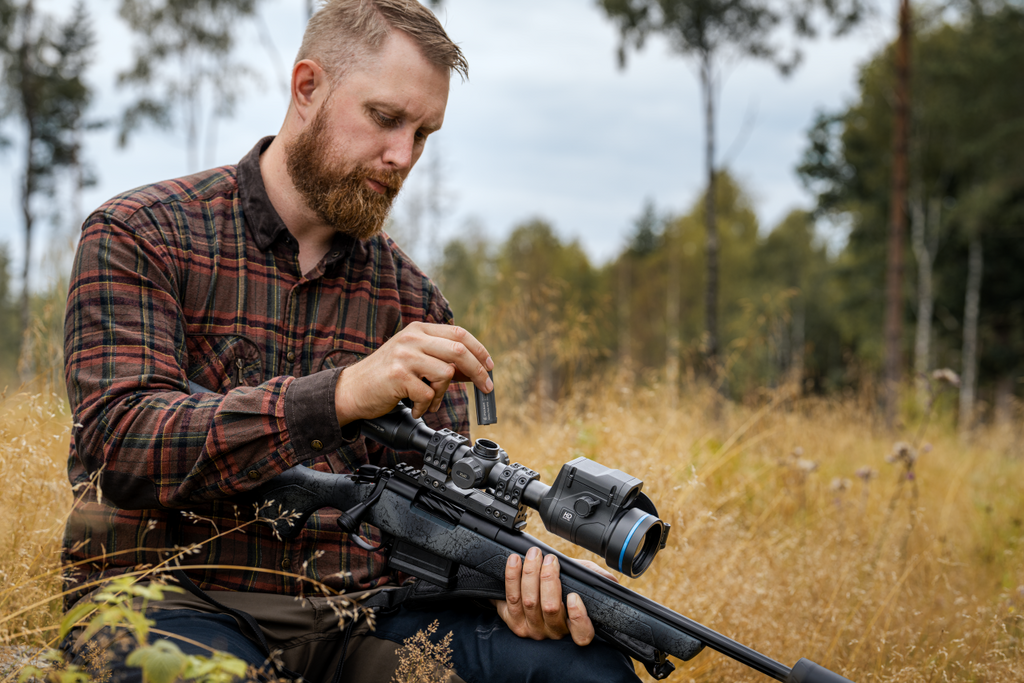
Cold weather reduces battery capacity significantly. A scope rated for eight hours at room temperature may deliver considerably less in freezing conditions, and many hunters discover this only after being caught without power at a critical point in a hunt.Extended observation sessions in stationary positions also drain power faster than brief scanning.
Battery systems designed specifically for field use - including replaceable packs and extended capacity options - allow hunters to carry spare power without interrupting the hunt. Understanding a scope’s actual runtime in the conditions you expect to hunt in is part of the evaluation, not an afterthought.
Mistake #6 - Underestimating environmental and weatherproofing needs
Thermal optics spend their working life in conditions that would damage ordinary electronics. Rain, snow, heavy fog, condensation, and sustained temperature swings are routine in hunting environments, not exceptions. A scope that performs well in dry laboratory conditions may underperform or fail entirely in the field.
Hunters who overlook durability ratings often discover this in the worst possible way, like water ingress during a wet evening, optical degradation after a fall, or electronic failure in remote terrain. IP ratings provide a standardised indication of water and dust resistance, with IPX7 indicating resistance to temporary submersion. Housing materials also matter: magnesium alloy provides greater structural protection than standard plastics.
Riflescopes built specifically for hunting environments combine sealed housings, rugged construction, and recoil resistance ratings that cover the calibers hunters actually use.

Mistake #7 - Ignoring real-life hunting use cases
Specification comparison is easy. Matching those specifications to how you actually hunt is harder, and it is where most buying mistakes originate.
A scope optimised for detecting foxes across open farmland at 400 meters will not perform the same way when used for tracking wild boar through dense woodland at 80 meters. The specifications that made it attractive for one scenario actively work against it in the other.
Different hunting styles require meaningfully different optical characteristics. Long-range shooting in open terrain favors high base magnification and extended detection range. Stalking in dense woodland calls for a wide field of view, compact form factor, and fast target acquisition at close range. Predator control at night sits somewhere between the two, with emphasis on thermal sensitivity and image clarity.
Matching the riflescope to the hunting scenario is the most reliable way to ensure the equipment works with the hunter in real conditions. The Pulsar thermal riflescope range is organised around these use cases, with distinct families designed for different priorities.
Mistake #8 - Not evaluating after-sale support and warranty
Thermal riflescopes are complex electronic devices, and they represent a significant financial investment. Like any precision instrument used in demanding conditions, they may eventually require service, firmware updates, or component repair.
The availability and quality of that support matter more with thermal optics than with passive glass, because electronics require specialised expertise that general optics workshops do not always have.
Warranty terms vary considerably across manufacturers. Some offer limited one-year coverage; others provide multi-year protection and explicit support for firmware updates that extend device capabilities over time. The difference becomes relevant when a device develops a fault outside the return window, or when a software issue affects performance and requires manufacturer resolution.
Choosing brands with established service networks and transparent warranty terms protects the investment and ensures that support is available when needed.
Why different thermal riflescopes make sense for different hunting situations
Every hunter who has bought the wrong scope eventually arrives at the same conclusion: the device was not the problem. The problem was expecting it to do something it was never built for.
Thermal riflescopes are not interchangeable tools. Each design reflects a specific set of priorities - reach, weight, sensitivity, handling speed - and those priorities were chosen with a particular type of hunt in mind.
Recognising this before buying changes the entire approach. The question shifts from which scope has the best specifications to which scope was designed for the way you actually hunt.
Thermal riflescope types and how hunters typically use them
The table below outlines the main use cases and the real-world characteristics that define each category in practice.
| Hunting situation / Use case | Seen in models like | How hunters typically use it | What stands out in the field |
| Best all-around performance | Thermion 2 LRF XL60 | Scanning open fields and mixed terrain for rapid target detection | High thermal sensitivity, wide field of view, HD-level image quality |
| Mobile hunting, small game |
Trail 3 LRF XR50 | Close- to mid-range detection in varied terrain | Compact and lightweight, long runtime, well- suited for semi- automatic platforms |
| Long-range hunting in open terrain | Thermion 2 LRF XG60 | Predator and varmint control in challenging conditions | Extended detection range, higher base magnification, integrated laser rangefinder |
| All-weather hunting | Thermion 2 LRF XP60 | Night hunting in humid, foggy, or low-contrast environments | Highest thermal sensitivity in its class, wide field of view at low base magnification |
| Mid-range detection and versaility | Trail 3 LRF XQ50 | Scouting, fast scanning, and spot-and-stalk for predator and hog hunting | Versatile compact format, built-in laser rangefinder, reliable in fog and rain |
Conclusion
Thermal riflescopes have enabled hunters to detect and identify game in conditions where traditional optics are simply not useful. But that capability only translates into results when the scope matches the actual demands of the hunt.
The eight mistakes covered here share a common thread: they all involve evaluating equipment based on what sounds impressive rather than what actually works in the terrain, conditions, and hunting style involved.
By considering these factors before purchasing, hunters avoid the frustration of discovering that their scope underperforms when it matters most. Whether upgrading from an older unit or buying a first thermal riflescope, the right starting point is an honest assessment of how and where you hunt.