In England and Wales, if you are 18 or over you can buy and own most air rifles without a licence, a certificate, or any police paperwork. The catch is the power limit. As long as the rifle produces less than 12 foot-pounds of muzzle energy, it sits outside the firearm certificate system entirely.
That is the short answer, and for a lot of buyers it is the whole answer. But three things trip people up; the power limit (especially on second-hand rifles), who is actually allowed to buy, and how the sale legally has to happen. Scotland also plays by completely different rules. This guide walks through the buying decision in roughly the order it matters.
The power limit decides whether you need a licence
The line between "buy it off the shelf" and "apply to your police force" is muzzle energy, not the look of the gun or what you plan to shoot.
For air rifles, the threshold is 12 foot-pounds. Below that, the rifle is a normal, unlicensed air weapon. At or above it, the rifle counts as a Section 1 firearm and you need a Firearm Certificate (FAC) to own it legally. Air pistols are tighter. Anything over 6 foot-pounds is prohibited without authority from the Home Secretary, which in practice puts high-powered air pistols out of reach.
Almost every rifle sold to general buyers in UK gun shops is built to come in just under 12 foot-pounds for exactly this reason. So if you buy new from a retailer and don't modify anything, you are very unlikely to cross the line by accident.
The second-hand and tuned-rifle trap
This is the part that catches private buyers out. A rifle's power can drift over the legal limit, and you cannot tell by looking at it.
A second-hand rifle may have been tuned, re-sprung, or fitted with a different mainspring or regulator by a previous owner. A PCP (pre-charged pneumatic) rifle can shift over time. If that rifle chronographs over 12 foot-pounds, it is legally a firearm, and possessing it without an FAC is an offence, even if you bought it in good faith believing it was sub-12.
If you buy used, get the rifle chronographed before you rely on it being legal. A reputable seller or gun shop can do this in minutes, and some will provide a reading on request. It is the cheapest insurance you can buy.
Are you actually allowed to buy one?
Being old enough is the first test, but it is not the only one.
You must be at least 18 to buy or hire an air weapon or its ammunition in England and Wales. A retailer who sells to someone under 18 is committing an offence, so expect age checks. The age rules below cover use as well as buying, because adults often buy with younger family members in mind.
- Under 14: can only use an air rifle under the supervision of someone aged 21 or over, on private premises where the occupier has given permission. They cannot have one unsupervised and cannot buy one.
- 14 to 17: can borrow and use a rifle unsupervised on private land with permission, but cannot buy, hire, or be given one as a gift, and cannot carry one in a public place unsupervised.
- 18 and over: can buy, own, and use freely, within the other rules in this guide.
So if you are buying a rifle for a 15-year-old to use on a relative's farm, you (the adult) buy and own it. The teenager can shoot it on that land, but the rifle is legally yours.
A criminal record can bar you even at 18+
Age is not the end of it. If you have been sentenced to a custodial or suspended sentence, you can be banned from possessing any firearm, including a low-powered air rifle.
A sentence of three months to three years triggers a five-year prohibition. A sentence of three years or more triggers a lifetime ban. Buying or possessing an air rifle while prohibited is a serious offence, and "I didn't think an air rifle counted" is not a defence. If this applies to you, check your position before you buy anything.
How buying one actually works
This is the bit most guides skip, and it is the most practical question for a buyer. Can you just order one online and have it posted to your door? Not quite.
In England and Wales, air weapons are sold through registered firearms dealers. You can browse, choose, and pay online, but the rifle cannot simply be dropped through your letterbox. The handover has to happen face to face between you and the dealer or their representative. In practice, that means either collecting from the shop or having it sent to a local registered dealer who hands it over to you in person once they have checked your age.
At that handover, expect to prove you are 18 or over. Accepted ID usually means a passport, a photocard driving licence, or a PASS-accredited proof-of-age card. If you look under the retailer's challenge age, bring it without being asked.

A genuine one-off private sale between two individuals also has to be done in person rather than posted, but the rules around who can sell air weapons by way of trade are stricter, and the precise mechanics of private transfers are an area where guidance is not always consistent. If you are buying privately, the cleanest route is to handle the exchange face to face and, if in any doubt, run it past the seller's dealer or your local police firearms licensing department first.
Scotland is a different country, legally
If you live in Scotland, or you are in England or Wales and plan to take a rifle there, the "no licence needed" answer does not apply.
Scotland requires an Air Weapon Certificate to use, possess, buy, or acquire an air weapon, unless a specific exemption applies. This is not a formality you sort out after buying. You generally need the certificate first. The system is well used; Police Scotland reported 31,598 air weapon certificates on issue as of 31 March 2025.
The age tiers also differ. A person under 14 cannot hold a certificate at all. Someone aged 14 to 17 can apply for a certificate but still cannot buy, hire, or own an air weapon. Visitors bringing a rifle into Scotland temporarily may need a visitor permit, of which Police Scotland granted 80 in 2024/25. The short version; do not assume an English purchase route works north of the border.
Northern Ireland
Northern Ireland is stricter again. Air weapons there are treated as firearms and require a firearm certificate, so the unlicensed route used in England and Wales does not exist. If you are buying in Northern Ireland, check the current requirements with PSNI firearms licensing before you commit to anything.
Once it's yours - storage and transport
Owning the rifle legally is not the end of your obligations. How you keep it and move it both carry rules, and the storage rules tightened in 2023.
Since 31 July 2023, the law in England and Wales spells out what "reasonable precautions" mean. When the rifle is not in use (and not being cleaned, repaired, tested, or transported), you must store it securely, out of sight, and separately from compatible ammunition. The aim is to stop unauthorised people, particularly under-18s, getting hold of it. These rules came in after a Home Office review prompted by a coroner following the death of 13-year-old Benjamin Wragge, which is worth keeping in mind when the storage requirements feel fussy.
In practice, a locked cabinet or secure cupboard out of view, with pellets kept somewhere separate, covers the legal expectation for a sub-12 rifle. There is no requirement for a full firearms-grade gun safe as there is with Section 1 firearms, but "reasonable" is judged on the circumstances.
Transport is about reasonable excuse. Carrying an air weapon in a public place without lawful authority or a reasonable excuse is an offence, and travelling to and from a place where you can lawfully shoot counts as a reasonable excuse. Keep the rifle unloaded and in a slip or gun bag, not on display, when you move it. Carrying one loaded or uncased in public can land you with a summary offence carrying up to six months' custody.
A quick word on where and what you can shoot
Buying the rifle does not give you anywhere to use it, so it is worth knowing the basics before you spend money.
You can shoot on private land where you have the occupier's permission. Garden shooting is allowed in principle, but only if every pellet stays within the boundary of the land where you have permission. Letting a pellet cross into a neighbour's garden or any land where you have no permission is an offence, so a solid backstop matters. It is also an offence to fire within 50 feet (about 15 metres) of the centre of a public highway if doing so interrupts or endangers anyone using it.
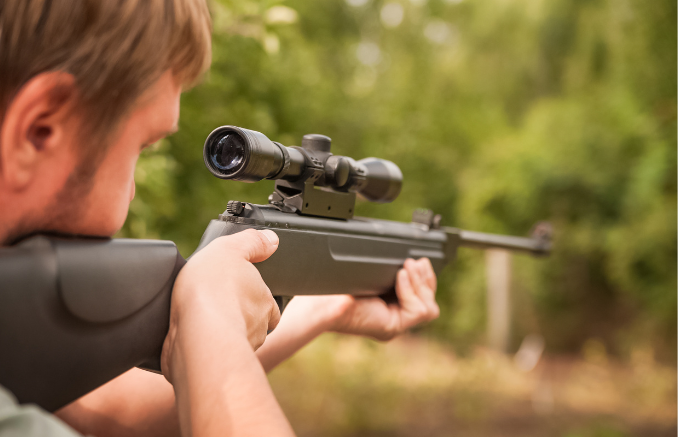
For pest control, certain species can be taken under general licences, and you are expected to shoot humanely and within animal welfare law. If that is your plan, read the relevant general licence for your nation before you start. Pellets themselves are largely unrestricted, but you still need to be 18 to buy them, and they should be stored separately from the rifle.
The bottom line for buyers
In England and Wales, an 18-plus buyer with no disqualifying convictions can buy a sub-12 foot-pound air rifle through a registered dealer, collect it in person, store it sensibly, and start shooting on permitted land, all without a licence. The risks that actually catch buyers out are a second-hand rifle that quietly exceeds the power limit, assuming a fully online no-contact purchase is allowed, and forgetting that Scotland and Northern Ireland require certificates up front. Sort those three out and the rest is straightforward.